104 MATCHES, 48 TEAMS: A STRATEGIC BREAKDOWN OF THE 2026 WORLD CUP
The 2026 World Cup isn't just bigger, it’s entirely different. From the complexities of the new 12-group format to the grueling logistics of the Round of 32, we decode the math, the geography, and the survival requirements of the largest tournament in sporting history.
THE LEGENDSTOURNAMENT INTELLIGENCE
KICKOFF USA 2026
3/14/202619 min read
48 Teams, 104 Matches: Decoding The New 2026 World Cup Format
Introduction: The End of The Traditional Bracket
Forget everything you know about the World Cup. The 64-match, 32-team structure that defined the sport from 1998 to 2022 is dead. In its place, FIFA has unleashed a beast: a 48-team, 104-match marathon that will sprawl across three nations, the United States, Canada, and Mexico.
This isn’t just an expansion; it’s a re-engineering of the global game. For the spectator, it means more football than the human brain can comfortably process. For the teams, it means a survival test that rewards squad depth over individual brilliance.
Chapter 1: The Mathematics of The Masses
Why 48? The answer is as much political as it is financial. By expanding the tournament by 50%, FIFA has effectively invited the "global periphery" to the party.
The 12-Group Architecture
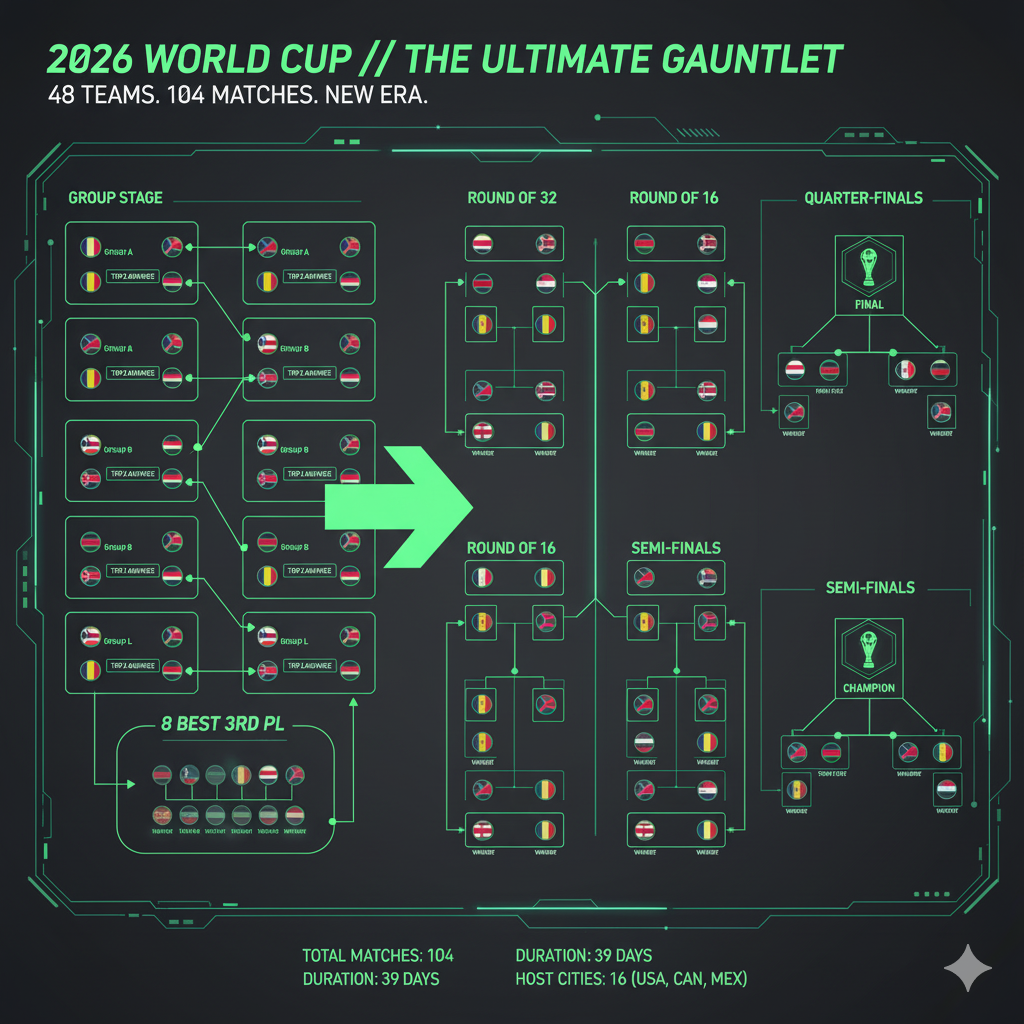
The original proposal, groups of three, was widely panned for its potential to encourage match-fixing and dead-rubber games. FIFA listened. We are getting 12 groups of four.
The Math: 12 groups x 4 teams = 48 nations.
The Progression: The top two teams from each group advance, alongside the eight "best" third-place teams.
This third-place qualification is the true game-changer. It ensures that almost every match in the group stage has massive stakes. A loss in Match 1 doesn't end a dream; it just forces a tactical pivot for Match 2. It creates a "points-table" tension that will keep fans glued to the standings well after the final whistle of the group stage.
The Geometry of Integrity — Why 12 Groups of 4 is The Only Way
When FIFA initially proposed the 48-team format, the blueprint featured 16 groups of three teams. On paper, it sounded efficient. In reality, it was a tactical disaster waiting to happen. The primary reason for the pivot to the 12 groups of four we see in 2026 is simple: the preservation of sporting integrity.
The "Gijón" Problem
In a three-team group, the schedule dictates that one team must sit idle during the final matchday. This creates the perfect conditions for collusion. Imagine a scenario where Team A and Team B play the final match of the group, knowing exactly what result they need to advance and simultaneously eliminate Team C. This is not a hypothetical fear; it is a historical scar. The infamous "Disgrace of Gijón" in 1982, where West Germany and Austria played out a mutually beneficial 1-0 result to eliminate Algeria, remains the gold standard for why three-team groups are toxic to the sport.
In a group of three, the "idle" team is powerless. They are forced to watch their fate be decided by a game they aren't part of, where the two teams on the pitch have every incentive to manipulate the scoreline to suit their joint interests.
The Four-Team Cleanliness
By shifting to 12 groups of four, FIFA has reintroduced the "simultaneous kickoff." When all four teams are active in the group, the final two matches occur at the same time. This architectural shift forces teams to play for the win rather than calculating a "safe" draw. It eliminates the ability for either of the two teams to collude because they cannot observe the outcome of their peers before committing to their own tactical approach.
Furthermore, groups of four offer a much higher statistical buffer against a single "bad day at the office." A team can suffer a surprise defeat in Match 1 and still recover through a win in Match 2. This structure ensures that the teams reaching the Round of 32 are the ones that demonstrated consistent quality, rather than those who simply benefited from a convenient scoreline in a three-team deadlock.
Ultimately, the group of four is the "gold standard" of tournament design. It protects the viewer from cynicism and ensures that the 104 matches are dictated by effort, sweat, and tactical genius, not by boardroom math or backroom handshakes.
Chapter 2: The Round of 32 - A new Level of Hell
In the 32-team era, the knockout stage was a sprint. It was a high-stakes, breathless dash toward glory; win three games, and you were in the final. It was a format that allowed for, and indeed romanticized, the "Cinderella Run." A tactically astute underdog could, through defensive discipline, a heroic goalkeeper, and a single lucky counter-attack, find themselves playing for a world championship.
In 2026, however, the script has been rewritten. The introduction of the Round of 32 transforms the tournament from a sprint into an endurance marathon. This is no longer a test of who can peak at the right time; it is a brutal, unyielding examination of who can survive the longest.
The Death of the Cinderella Run
To reach the trophy in 2026, a team must now win four knockout games instead of three. While the addition of one game may seem mathematically insignificant to the casual observer, to a sports physiologist or a national team manager, it is a tectonic shift.
In previous iterations, the knockout phase allowed for a "puncher’s chance." A team could rely on the brilliance of one or two superstars to carry them through the Round of 16 and the Quarter-finals. By the time the Semis arrived, the finish line was in sight; the adrenaline of the occasion could override physical fatigue. But in 2026, the Round of 32 acts as a filter that punishes narrow rosters. By adding this layer, FIFA has effectively killed the "lucky streak" narrative. A team that relies on a singular superstar or a static, defensive game plan will almost certainly run out of gas before it reaches the quarter-finals. The math is simple: the more games you play, the more your weaknesses are exposed, and the more your luck eventually runs out.
The "Squad Depth" Revolution
This change mandates a radical restructuring of how national teams are built. Coaches can no longer afford the luxury of a "fixed" starting XI. In the modern, high-intensity game, where tactical pressing has become the global standard, players are red-lining their physical output every 90 minutes. In 2026, with matches separated by only three or four days, the "bench" effectively becomes the most important unit on the team.
This shift fundamentally rebalances the global hierarchy. It favors nations with deep, interchangeable talent pipelines, such as the United States, France, Brazil, and Germany, over nations that lean on one or two aging or fragile icons.
For a team like the U.S., which has spent years cultivating a roster where the drop-off from the starter to the substitute is minimal, this format is a strategic gift. In a 32-team tournament, a coach might be afraid to rotate players for fear of losing cohesion. In 2026, not rotating is a death sentence. We are going to see coaches treating their roster like a chess set, strategically resting key assets in the group stage to ensure they are at 100% for the Round of 32.
The Psychological Toll of the "Extra" Game
Beyond the physical requirements, we must consider the psychological weight of the Round of 32. In a tournament of 104 matches, the pressure to maintain momentum is relentless. In the old format, the knockout stage felt like a singular "event" that you could prepare for mentally. In this new marathon, the mental fatigue of maintaining focus over an extra week of high-stakes football will be unprecedented.
Players will be living in a state of hyper-vigilance for nearly 40 days. The risk of burnout is no longer just physical; it is cognitive. The Round of 32 introduces a new kind of "tournament anxiety." If a team scrapes through their group, they are immediately thrown into a high-intensity knockout game before they’ve had the chance to recalibrate. The margin for error has effectively vanished.
A New Metric for Success: "Squad-Wide Competency"
As we look toward 2026, the teams that hoist the trophy will be those that view their 26-man roster as a singular, fluid entity. We expect to see "Tactical Periodization" become the primary focus of national team camps. Coaches will be mapping out specific "minute-shares" for their players, ensuring that no single player is over-extended before the quarter-finals.
The Round of 32 essentially forces the World Cup to become a test of organizational infrastructure. The nations that succeed will be those with the best sports science departments, the most robust travel protocols, and the deepest talent pools. The romance of the underdog is being replaced by the cold, calculated efficiency of the machine. It is a new level of hell for the managers, a new standard for the players, and a brand-new way to experience the greatest sporting event on earth.
The question for 2026 is no longer, "Who has the best players?" It is, "Who has the best 26?" The marathon has begun, and the deep squads are the only ones equipped to survive the heat.
Chapter 3: The Geographical Monster
Hosting a tournament across three countries and 16 cities creates a logistics nightmare that FIFA has dubbed a "Regionalized Tournament."
The Travel Burden
In previous World Cups, teams could base themselves in one city and play in a stadium 60 minutes away. In 2026, a team could play their opening game in Vancouver, their second in Miami, and their third in Mexico City.
The "Air Mile" Tax: The fatigue caused by crossing time zones will be a major tactical factor. We will see teams hire "sleep doctors," private jets, and high-altitude training camps specifically to combat the travel-induced drop-off in performance.
The Logistical Quirks of A Tri-Nation Tournament
In a tournament spanning 16 cities, the "Home-Pitch Advantage" is being replaced by the "Geographical Variable." As teams hop between these massive urban hubs, they are effectively competing against two opponents: the team on the pitch and the environment itself.
The Mexico City Factor: Thinner Air, Higher Stakes
At an elevation of 7,350 feet, Mexico City’s legendary Estadio Azteca is a tactical graveyard for the unprepared. The reduced oxygen levels aren’t just a challenge for the lungs; they fundamentally alter the physics of the game. At altitude, the ball travels faster and curves less predictably. For teams used to a low-block, possession-based game at sea level, the high-altitude pressure and the sheer physical toll on recovery often lead to a "second-half collapse." Coaches will need to rotate their entire starting XI just to manage the aerobic load, making the Round of 32 in Mexico City a distinct strategic challenge compared to games played at sea level.
The Miami Crucible: Humidity as a Tactical Variable
Conversely, Miami presents a battle against the elements. The extreme humidity of South Florida acts as a thermal blanket, trapping body heat and accelerating dehydration. While the Azteca challenges the cardiovascular system, Miami challenges the autonomic nervous system. Matches here will likely see a decline in high-intensity sprinting by the 60th minute, favoring teams that prioritize ball retention and lateral passing over a chaotic, high-pressing game. Navigating these two extremes, altitude and humidity, is the ultimate test of 2026 logistical preparation.
Chapter 4: The Pride of The Periphery
The World Cup has historically been a guarded club. For decades, the qualification processes acted as a moat, keeping the "global periphery" at bay while the traditional powerhouses of Europe and South America monopolized the stage. In 2026, the expansion to 48 teams has finally drained that moat. We are witnessing the largest injection of new blood in the history of the sport, and for the first time, the tournament is truly representative of the global game.
These debutants are not merely here to fill the bracket or pad the goal differences of the giants. They are here as the living embodiment of the "American Odyssey", a testament to the fact that talent is distributed equally across the globe, even if opportunity hasn't always been.
The Tactical Frontier: Uzbekistan
When you analyze the rise of Uzbekistan, you are not looking at a team built on luck; you are looking at the product of decades of tactical discipline and Central Asian grit. Uzbekistan has long been the "nearly man" of Asian football, consistently pushing the traditional powers to the brink. Their arrival in 2026 represents the fruition of a highly sophisticated youth development program that prioritizes collective structure over individual flair.
For the casual fan, watching the "White Wolves" will be a masterclass in organized resistance. Their defensive block is legendary in AFC play, characterized by a low-to-mid block that frustrates even the most expensive attacking squads. However, it is their transition game, characterized by lightning-fast vertical passes, that will cause headaches for established giants who are used to controlling possession. Uzbekistan brings a physical, high-intensity style that mirrors the harshness of the steppe, and they are arriving in North America with a point to prove. They are the tactical wildcards of the tournament, the team that the "Big Five" leagues and their scouting departments know the least about.
The Fearless Attack: Jordan
If Uzbekistan is the stone wall of the debutants, Jordan is the hurricane. Emerging from a series of massive performances in the Asian confederation, Jordan has developed an identity built on pure, unadulterated aggression. They do not play to contain; they play to conquer.
What makes Jordan so dangerous in a 48-team format is their forward-thinking philosophy. They possess a cohort of attacking players who operate with a freedom rarely seen at the international level. They press high, they move the ball with urgency, and they have an innate ability to find the back of the net when the pressure is at its peak. In a 104-match tournament, teams that play with this level of intensity often find themselves rewarded in the group stages. They are the embodiment of the modern underdog: unafraid of reputations, indifferent to the pedigree of their opponents, and hungry to turn the bracket on its head. For fans seeking "World Cup Magic," Jordan is the team to watch in the early, high-energy group stage matches.
The Technical Elegance: Cape Verde
Representing the African continent, the "Blue Sharks" of Cape Verde bring a level of technical flair and improvisational brilliance that is quintessentially their own. Emerging from a small archipelago off the coast of Senegal, Cape Verde has punched above its weight class for years, utilizing a scouting network that spans the diaspora to build a roster of technically gifted players who are comfortable in possession and creative under pressure.
Their style is not just about raw athleticism; it is about the "rhythm" of the game. Cape Verdean football is characterized by quick, short-passing combinations and the ability to find creative solutions in tight spaces. They are the kind of underdog story that made 1994 so iconic, the team that arrives with no expectations and leaves with the admiration of the world. By bringing a style of play that is so distinct from the rigid, tactical paradigms of Europe, they represent the true value of the expansion. The World Cup is meant to be a showcase of global cultures, and the Blue Sharks bring a vibrant, technical personality to the North American stage that will make them an instant favorite for neutral fans.
Why the "Big Five" Should Be Concerned
The arrival of these debutants poses a significant problem for the traditional elite. Modern professional football, particularly in the "Big Five" European leagues, has become increasingly homogenous. Tactical systems have been copied and pasted, leading to a landscape where every top-tier game feels somewhat familiar.
These debutant nations, however, operate outside of that ecosystem. They bring methodologies, mentalities, and rhythms that aren't practiced on the training grounds of Manchester, Madrid, or Munich. When a team like Uzbekistan forces a giant into a 90-minute deadlock, or when Jordan breaks open a defense with unconventional, high-speed movement, they aren't just playing football; they are disrupting the established order.
For the tournament to be a success, we need these teams to succeed. We need the "pride of the periphery" to challenge the status quo. These nations provide the unpredictability that drives engagement, the stories that fill the headlines, and the grit that reminds us why we fell in love with the game in the first place. They are not here to observe history; they are here to write it. As we approach the 104-match marathon, remember the names of these debutants. They are the heartbeat of the 2026 expansion, and they are exactly what the World Cup needed to remain relevant in a changing world.
Chapter 5: The 39-Day Marathon - The Logistics of Tactical Endurance
Thirty-nine days. To the casual observer, it’s just a calendar span. To the sports scientist, the head coach, and the tactical analyst, it is a period of sustained physiological and cognitive stress that represents the ultimate frontier of modern football. For context, the 2022 Qatar World Cup concluded in just 29 days. That ten-day difference is not merely an extension; it is an escalation that fundamentally alters the DNA of how a tournament must be navigated.
In 2026, the World Cup is no longer a sprint; it is an ultramarathon where the finish line requires more than just skill, it requires an unprecedented masterclass in biological and tactical management.
The Zenith of Sports Science
In 2026, the victory will not necessarily go to the team with the best starting XI, but to the team with the best "periodization" plan. Periodization is the science of training and recovery, and it has reached its absolute zenith in preparation for this tournament. Coaches are no longer managing games; they are managing cellular recovery, glycogen replenishment, and hormonal balance across a squad of 26 players.
The challenge here is the "human battery." If a player plays every minute of a deep run to the final, they are looking at seven matches in 39 days. Add the travel demands of a transcontinental tournament, where teams shuttle between time zones and climates, and you have a recipe for systemic fatigue. Teams are now utilizing advanced biometric monitoring to track "load management." We are seeing the death of the "star player who plays every minute." Instead, we are entering the era of the "controlled asset," where coaches use data to decide exactly when a player must be substituted to prevent the onset of micro-trauma or cumulative metabolic fatigue.
The Tactical "Mid-Tournament Dip"
The expansion of the timeline introduces a fascinating, albeit controversial, phenomenon: the mid-tournament dip. In previous, shorter tournaments, the intensity was sustained from the opening whistle to the final. In 2026, we anticipate a visible slowing of the game’s tempo during the latter half of the group stages.
This isn’t a lack of effort; it is tactical conservation. Because the "Round of 32" looms immediately after the group stage, teams that have already secured qualification or feel their progression is safe will deliberately engage in "low-intensity football." We expect to see a spike in tactical draws and low-scoring, possession-heavy stalemates. In these matches, the goal is not to entertain; it is to keep the ball in areas of low risk while minimizing the physical exertion of the squad. The "Mid-Tournament Dip" is a survival mechanism, a way to hoard physical capital for the knockout rounds, where a single mistake results in immediate elimination.
The High-Press Crisis
Perhaps the most significant tactical evolution we will witness is the crisis of "Gegenpressing." High-energy, vertical, high-pressure systems, which have defined the last decade of football, rely on a ferocious level of intensity. These systems require players to sprint constantly, track back relentlessly, and engage in high-impact physical duels.
Can you maintain that level of intensity for 39 days? The physiological data suggest a hard "no." A team that attempts to press high from Match 1 through to the Final will likely find their legs gone by the Quarter-finals. We are already seeing a reactionary shift in the coaching world: a return to "controlled-possession" and the "mid-block." Instead of the frantic, chaotic energy of the high-press, the 2026 champions will likely be teams that prioritize the ball. By holding possession, a team exerts control without the need for constant, lung-busting sprints. It is a more conservative, efficient use of energy. The team that wins the 2026 World Cup will likely be the team that knows how to slow the game down, forcing their opponents to chase the ball and exhaust themselves in the process.
Survival as Strategy
Ultimately, the 39-day format changes the very definition of a "winning team." Winning at the 2026 World Cup is no longer just about the tactical genius of the coach on the bench; it is about the structural integrity of the entire organization. It is about having a bench that can step in without a drop-off in quality, a travel strategy that minimizes sleep deprivation, and a tactical philosophy that favors efficiency over extravagance.
Fans who are accustomed to the explosive, end-to-end nature of previous tournaments may find the group stages of 2026 to be more methodical, even tactical to a fault. But this is the price of the marathon. The teams that survive the "Mid-Tournament Dip" and avoid the "High-Press Crisis" will be the ones standing on the podium. In the 39-day marathon, patience is the greatest weapon, and endurance is the ultimate form of skill. The World Cup has moved beyond the beautiful game, it has become the ultimate game of tactical survival.
Chapter 6: How to Watch (And Survive) The 104
With 104 matches spread across 39 days, the 2026 World Cup represents the largest logistical undertaking in sporting history. For the casual viewer, this is a banquet; for the dedicated fan, it is a test of endurance. It is physically impossible to watch every second of the tournament without sacrificing your professional life, your sleep cycle, and your sanity. To survive this, you must stop being a spectator and start being a "Tactical Curator."
The "Dossier" Approach to Curation
The days of casually tuning in to every match are over. If you attempt to watch all 104 matches, you will succumb to "tournament fatigue" before the Round of 32 even kicks off. Instead, you need a strategy, a systematic approach to filtering the signal from the noise.
1. The Third-Place Race: Your Primary Metric
In the 32-team era, the group stage often featured "dead rubber" matches, games where the outcome was irrelevant to the standings. The 2026 format, which sees the eight best third-place teams advance to the Round of 32, effectively eliminates this. Every single matchday matters.
Start a digital spreadsheet or use a dedicated tracking app to monitor the "Third-Place Table." Because the knockout bracket is partially determined by which third-place teams advance, you aren’t just watching one group; you are watching how the performance of a team in Group A might inadvertently decide the path of a team in Group L. This makes the group stage a dynamic, interconnected puzzle. If you want to understand the "true" narrative of the tournament, stop focusing on the big-name head-to-head clashes and start tracking the goal-difference margins of the third-place contenders. That is where the real drama lives.
2. Follow the Travel: The "Fatigue Factor"
In a tournament spanning 16 cities and three countries, distance is the ultimate equalizer. When analyzing the bracket, look for teams caught in the "Trans-Continental Bracket." If a team plays their opening match in Vancouver, their second in Miami, and their third in Mexico City, they are covering thousands of miles while dealing with extreme shifts in humidity and altitude.
When the Round of 32 arrives, look closely at the travel logs of the teams involved. A team that has spent the previous two weeks in a high-altitude training camp in Mexico, only to be forced to fly to Toronto for a knockout match, will likely face a significant drop-off in physical performance. As a fan, this is your hidden edge. Understanding the logistics allows you to predict upsets that the rest of the viewing public will dismiss as "luck."
3. The "Dossier" Strategy: Localized Intelligence
The 2026 World Cup is a 16-city sprawl. If you are traveling, the "Last Mile" is your primary constraint. Navigating the sheer density of fans, the localized transport gridlock, and the specific stadium entry protocols requires more than just a ticket; it requires localized intelligence.
The "Dossier" approach is about preparing for the environment of the city as much as the tactics of the pitch. Whether it is knowing which metro line offers the quickest exit from SoFi Stadium after a match or understanding how to navigate the heat-mitigation zones in a humid host city, your experience is entirely dependent on your preparation. Those who try to "wing it" will spend their tournament trapped in transit hubs, watching the match on a pixelated phone screen while stuck in traffic. Those who curate their experience, booking their transport, understanding the local stadium quirks, and knowing exactly where the "Fan Fest" zones are located, will be the ones who actually see the game.
The Curator’s Mindset
To survive the 104, you must treat your viewing schedule with the same rigor as a professional coach.
Prioritize the Knockout Path: Don’t feel guilty about skipping a group stage match if it doesn't impact your "Third-Place" spreadsheet. Save your energy and focus for the Round of 32 and beyond.
Master the Shift: Learn to recognize the "tactical dip." By the second week of the group stages, matches often become slower and more cautious. This is the perfect time to switch from live viewing to recap-analysis.
Engage with the Community: The 104-match marathon is too complex for one person to track alone. Use your digital tools, join community forums, and lean into the data-driven side of the tournament.
Ultimately, watching the 2026 World Cup is about choices. You are choosing which slice of history to witness. By adopting a "Dossier" approach, you transform from a passive observer into an active participant in the largest logistical experiment in the history of sports. Don't just watch the matches, curate them. Because the rise of the American Golden Generation is worth the effort, but only if you have the intelligence and precision to be there when it happens.
Conclusion: A New Era for The Sport - Embracing The Magnitude
The 2026 World Cup is not merely a tournament; it is a fundamental shift in the architecture of global sport. For the better part of three decades, the World Cup was defined by a specific, manageable cadence, a predictable 64-match rhythm that allowed for intimacy, intense focus, and a singular narrative arc. By expanding to 48 teams and 104 matches, FIFA has shattered that mold, pushing the sport into an era of continental endurance that is as sprawling as the North American landscape itself.
This shift is not just about the numbers. It is a transition from a sport that rewards fleeting moments of perfection to a sport that demands, above all else, sustained structural endurance.
The Philosophy of the Gauntlet
In the 32-team format, a team could win the title by being the most talented unit for four weeks. In 2026, talent is no longer the sole variable. The addition of the Round of 32, combined with the logistical sprawl across sixteen host cities, means the trophy will be lifted by the most resilient organization.
This tournament will be messy. There will be logistical hiccups, unexpected travel fatigue, and climate shifts that disrupt the best-laid tactical plans. But in that messiness lies the beauty of the 2026 experiment. We are moving away from the "curated" perfection of the past and into an era of raw, untethered spectacle. The narrative of 2026 will not be written by the team that plays the most beautiful football in the group stages, but by the team that manages their squad rotation, their health, and their mental focus through the crucible of the 39-day marathon.
The "Last Mile" Legacy
For the fan, this expansion requires an evolution of the spectator mindset. We are moving beyond the traditional fan experience, the "watch-and-cheer" approach, and into the role of a logistical strategist. You are now the "Tactical Curator" of your own experience. Whether you are tracking the complex interdependencies of the third-place qualifying table or navigating the hub-and-spoke transit networks of the host cities, you are participating in a massive, collaborative effort to witness history.
If you approach 2026 with the tools of 2022, you will be overwhelmed. The scale of the event demands a shift in how we engage with the game. We must look closer at the data, respect the impact of the environment, and understand that every match, no matter how obscure the nations on the pitch, is a piece of a larger, interconnected, 104-match puzzle.
Why the 2026 Odyssey Matters
Why embrace this complexity? Because we are witnessing the birth of a global footballing superpower in the United States, fueled by a "Golden Generation" that has been cultivated with scientific precision. 2026 is their stage, but it is also the stage for the debutants—the Uzbekistans, Jordans, and Cape Verdes of the world, who are finally getting their seat at the table.
This expansion is about inclusivity, but it is also about pressure. It forces every team, big or small, to confront the limitations of their own resources. It democratizes the struggle, forcing the established powers of Europe and South America to adapt to the same logistical realities that the underdogs have faced for years.
Your Call to Action: Mastering the Marathon
As we look toward the opening kickoff, one thing is clear: the only way to experience this scale of history is with a strategy in place. The marathon has begun. The finish line is 39 days and 104 matches away. You have the dossier, you have the tactical understanding of the format, and you know the logistical hazards of the host cities.
Will you be a spectator, or will you be part of history? The 2026 World Cup will be the biggest spectacle in the history of sports, unprecedented, sprawling, and exhilarating. It is time to stop watching the game and start mastering the gauntlet. History is waiting, and for the first time, it’s being played on a scale that forces everyone to raise their game. Secure your roadmap, lock in your logistics, and prepare for the 39-day ride of a lifetime. The game has changed forever, and you are ready for the challenge.