500 MILLION REQUESTS: 2026 WORLD CUP SET TO SHATTER EVERY ATTENDANCE RECORD
Soccer is officially taking over North America. As FIFA prepares to obliterate the 1994 attendance record, the final ticket sales phase has been triggered. We go inside the numbers to show you where the best chances are, how the "Steel Ring" digital tickets work, and why April 1st is your last stand for a guaranteed seat in 2026.
BREAKING NEWS
KICKOFF USA 2026
3/26/20265 min read
🚨THE GOLDEN TICKET: FIFA Announces Final Sales Phase as 2026 World Cup Shatters Global Records
ZURICH / NEW YORK — If you haven’t secured your seat for the greatest sporting spectacle in human history, the clock has officially entered stoppage time.
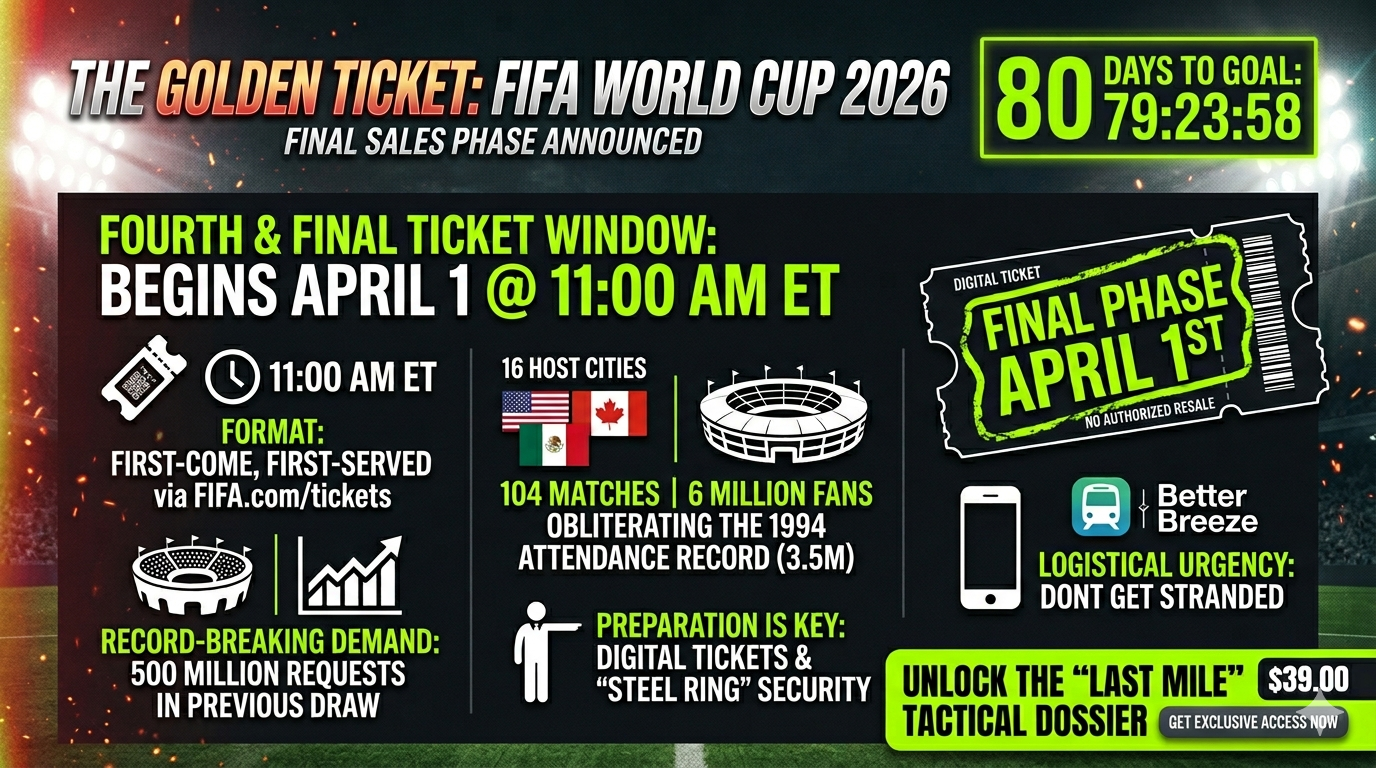
FIFA confirmed yesterday that the fourth and final ticket sales phase for the FIFA World Cup 2026 will officially commence on April 1, 2026, at 11:00 AM ET. Unlike the previous randomized draws that defined the earlier windows, this final stage will operate on a brutal, high-stakes first-come, first-served basis via the official portal at FIFA.com/tickets.
The announcement comes amidst a backdrop of unprecedented global demand. FIFA officials revealed that the previous draw handled a staggering 500 million ticket requests, a number that highlights the sheer scale of the 2026 tournament. With the expansion to 48 teams and matches spread across three sovereign nations, Canada, Mexico, and the United States, the 2026 edition is no longer just a tournament; it is a continental takeover.
As it stands, FIFA is not just on track to break records; it is on track to obliterate them. The current attendance record, held by the 1994 World Cup in the USA (3.5 million attendees across only 52 matches), is expected to fall by mid-tournament. With 104 matches on the schedule for 2026, the projected attendance is set to surpass 6 million fans, effectively doubling the 1994 benchmark.
1. The Chaos of the First-Come, First-Served Format
The shift from a "Lottery" system to "First-Come, First-Served" (FCFS) marks a significant tactical change for fans. In the previous phases, fans could submit their applications over a period of weeks, knowing that their chances were equal to everyone else’s.
On April 1st, that luxury vanishes.
This final phase is the "digital Hunger Games" of sports ticketing. When the portal opens at 11:00 AM ET, millions of users will hit the servers simultaneously. In previous World Cups, this has led to digital queues that stretch into the hundreds of thousands, with high-demand matches (like the Final at MetLife Stadium or Mexico’s openers at Estadio Azteca) selling out in a matter of seconds.
Tactical Advice for April 1st:
Account Readiness: Ensure your FIFA ticketing account is active, your payment details are pre-saved, and your "Fan ID" information is up to date.
The Device Strategy: Use a hard-wired internet connection if possible. Wi-Fi lag of even half a second can be the difference between a Category 1 seat and a "Sold Out" screen.
The Match Priority List: Don't go for the Final first if you want a guaranteed seat. Everyone is hitting the Final. Aim for the "High Value" Group Stage matches or Round of 32 fixtures in cities like Atlanta, Dallas, or Vancouver where stadium capacities are larger.
2. Breaking the 1994 Ghost: Why 2026 is Different
For three decades, the 1994 World Cup has been the gold standard for soccer attendance. It was the tournament that proved North America was a sleeping giant for the sport. However, the 2026 edition is a different beast entirely.
Expansion and Exposure:
The leap from 32 to 48 teams has added 40 additional matches to the schedule. This means more "Blue Chip" matchups across more time zones. The inclusion of heavyweights who struggled in previous cycles, alongside emerging powers from Asia and Africa, has created a secondary market demand that FIFA has never seen before.
The Stadium Scale:
Unlike Qatar 2022, which relied on newly built, smaller-capacity stadiums, or Russia 2018, the 2026 venues are "behemoths." Stadiums like AT&T Stadium (Dallas) and MetLife Stadium (New York/New Jersey) are built for American Football crowds of 80,000 to 100,000. Even with FIFA’s seating configurations, the sheer volume of available tickets per match is massive, yet the 500 million requests prove that even these giants aren't big enough to house everyone.
3. The "Last Mile" Logistical Reality Check
Securing a ticket is only half the battle. As we’ve discussed in our Last Mile Dossier, the logistics of the 2026 tournament are the most complex in history. With matches spanning from the Pacific Northwest to the Gulf of Mexico, the "fan journey" is fraught with potential bottlenecks.
The Transit Surge:
FIFA’s announcement yesterday also hinted at "Enhanced Transport Integration" for ticket holders. This is a direct response to the concerns over the "Better Breeze" transit rollout in Atlanta and the "Steel Ring" security sweeps.
If you win a ticket in this final phase, you aren't just buying a seat; you are entering a high-security ecosystem. FIFA confirmed that your digital ticket will be linked directly to your Fan ID, which will serve as your "passport" through security perimeters.
The Infrastructure Tax:
Host cities are already reporting that hotel prices within a 50-mile radius of the stadiums have surged by 600% for match weeks. This is why the April 1st phase is so critical: the longer you wait to confirm your ticket, the more "logistically stranded" you become.
4. Category Pricing: What to Expect
FIFA has maintained a tiered pricing structure to ensure "accessibility," though critics argue that the premium seats are becoming increasingly out of reach for the average fan.
Category 1: Prime sideline views. Expect these to start at $600+ for Group Stage matches and soar into the thousands for the Knockout rounds.
Category 2 & 3: The "Heart of the Stadium." These are the most sought-after by true supporters.
Category 4: Reserved exclusively for residents of the host nations (USA, Canada, Mexico). These are the most affordable tickets, designed to ensure that the local population isn't priced out of their own party.
A Note on Resale: FIFA has reiterated a Zero-Tolerance Policy for unauthorized resale. Tickets must be transferred through the official FIFA Resale Platform. If you buy a ticket from a third-party site on April 2nd, you run a 90% risk of having the ticket deactivated at the "Steel Ring" security checkpoint.
5. The "Steel Ring" and the Digital Ticket Era
For the first time, 2026 will be a 100% Digital Ticket tournament. There will be no paper tickets, no "PDF prints," and no exceptions.
The tickets will utilize "Rotating QR Code" technology. This means your ticket code changes every few seconds and only becomes active when you are within the geofenced "Steel Ring" of the stadium. This tech is designed to kill the scalping market, but it also means fans need to be tech-literate and have reliable mobile data.
The Connectivity Challenge:
In our Last Mile testing, we found that cellular networks often "choke" when 80,000 fans try to refresh their ticket apps at Gate 1. FIFA has promised "Stadium-Wide High-Density Wi-Fi," but veteran fans know to cache their tickets in their mobile wallets before they even leave their hotel room.
6. Why April 1st is Your Last Stand
After the April 1st phase closes, the only remaining tickets will be "returns", tickets that fans can no longer use and put back into the official resale pool. These are rare, unpredictable, and usually limited to single seats.
If you are a family of four or a group of friends trying to sit together, April 1st is your only option.
The sheer volume of interest—500 million requests-suggests that for every one person who gets a ticket, ninety-nine will be left watching from a Fan Zone. But in the 2026 World Cup, even the Fan Zones are becoming "ticketed events" due to the massive crowds expected in cities like Mexico City and Los Angeles.
Final Verdict: Preparation is Everything
The 2026 World Cup is a once-in-a-lifetime convergence of three nations. It is the moment soccer finally takes its seat as the undisputed king of North American sports. But as the "Record Pace" suggests, the world is coming to our doorstep, and they are bringing their passion and their wallets with them.
Do not wait for April 2nd. Set your alarms for 11:00 AM ET on April 1st. Have your FIFA login ready. Have your "Last Mile" transit plan mapped out.
Because when 3.5 million seats are being chased by 500 million people, the "First-Come, First-Served" rule is the only law that matters.