ATLANTA'S WORLD CUP "MOBILITY BACKBONE": GEORGIA TRANSIT LEADERS UNVEIL 2026 INFRASTRUCTURE PLAYBOOK
91 Days to Kickoff: Atlanta unveils the 'Mobility Backbone' for FIFA 2026. Get the tactical intel on MARTA’s new CQ400 railcars, the SEC District station rebranding, and the SCAD 'Last Mile' wayfinding icons. Don't get stuck in the gridlock—read the full transit playbook now.
HOST CITIESTACTICAL BRIEFINGS
KICKOFF USA 2026
3/13/20264 min read
🚨 STATUS: GREEN LIGHT — Atlanta Unveils "Mobility Backbone" for 2026 World Cup
ATLANTA, GA — On Thursday, March 12, 2026, against a backdrop of escalating global tensions, Georgia’s transportation titans gathered at Mercedes-Benz Stadium for a "95 Days to Kickoff" summit. Their message was singular, defiant, and tactically precise: Atlanta is built to host the world.
While the geopolitical landscape remains volatile, the "Georgia Playbook" for the FIFA World Cup 2026 is officially operational. Led by the Metropolitan Atlanta Rapid Transit Authority (MARTA) and the Georgia Department of Transportation (GDOT), the briefing detailed an unprecedented $120 million surge in infrastructure, technology, and "Last Mile" logistics designed to move millions of fans without a single private vehicle entering the downtown core.
The "Let MARTA Drive" Campaign: Zero-Latency Rail
The centerpiece of the summit was the formal launch of the "Let MARTA Drive" initiative. For the duration of the tournament (June 12 – July 19), MARTA will pivot from a commuter-focused schedule to a "High-Frequency Battle Rhythm."
The Tactical Rail Specs:
5-Minute Headways: On match days, MARTA will operate trains at five-minute intervals from 5:00 AM until 10:30 PM. This "Zero-Latency" model is designed to prevent the platform overcrowding seen during the 1996 Olympics.
The CQ400 Fleet Debut: MARTA CEO Jonathan Hunt confirmed that seven brand-new CQ400 Stadler railcars, the most technologically advanced in North America, will be in active service by June. These cars feature open gangways, allowing fans to move between cars to balance crowd density in real-time.
If you’re traveling internationally, MARTA’s contactless system is a relief, but you’ll want to have our [Host City Survival Guide] downloaded for a full breakdown of the other tech tools you’ll need to navigate the U.S. successfully.
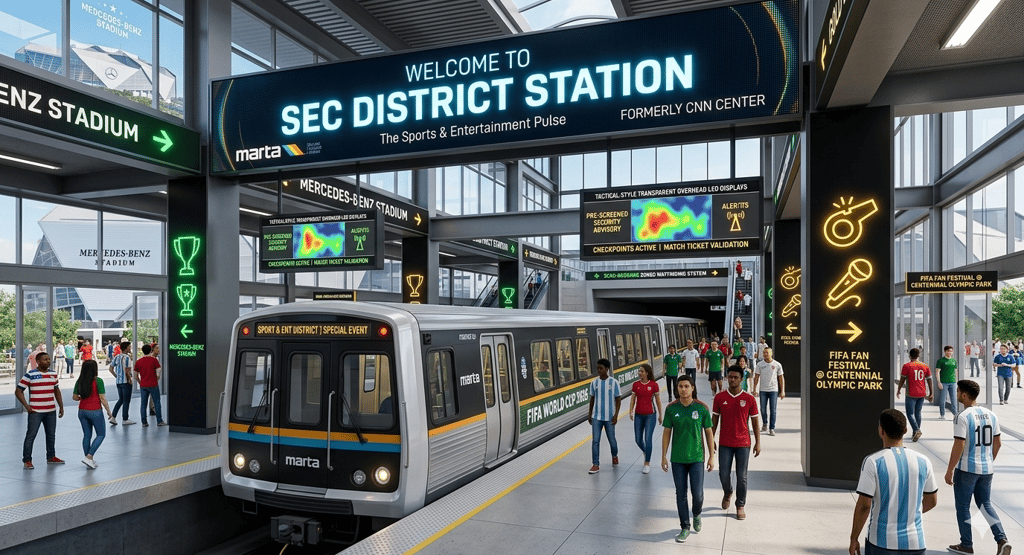
Pocket Track Staging: To handle the "Exit Surge" after the final whistle at Mercedes-Benz Stadium, MARTA will stage "Ghost Trains" in hidden pocket tracks near the SEC District Station (formerly CNN Center), ready to deploy within 90 seconds of a crowd spike.
Digital Sovereignty: The End of the Paper Ticket
In what leaders are calling a "New Era of Transit," Georgia confirmed that the transition to the "Better Breeze" payment system will be 100% complete by May 2nd.
For international travelers, this is the most critical update: You no longer need to wait in line at a kiosk. The entire MARTA system now supports Open-Loop Contactless Payment. Fans can simply tap their iPhone, Android, or international Visa/Mastercard directly at the turnstile.
Field Advisory: While digital is king, MARTA is releasing a Limited-Edition FIFA World Cup 2026 physical Breeze Card on April 15th. For collectors, these will be the "1996 Olympic Pins" of this generation.
The "Last Mile" Strategy: A Zoned Wayfinding System
One of the most innovative reveals came from a partnership with the Savannah College of Art and Design (SCAD). Recognizing that Atlanta’s downtown can be a labyrinth for non-English speakers, SCAD designers have implemented a "Zoned Wayfinding System" for the "Last Mile", the stretch between transit hubs and the Fan Festival at Centennial Olympic Park.
The Visual Language:
Instead of text-heavy signage, the city is deploying "Soccer-Centric Iconography." * The Green Zone: Leads to the Stadium via the North-South rail line.
The Gold Zone: Leads to the 16-day FIFA Fan Festival.
The "Soccer Ball" Installations: Massive, branded soccer ball sculptures will serve as physical landmarks and photo ops, doubling as intuitive meeting points for "squads" who get separated in the crowd.
GDOT’s "Tactical Playbook": Regional Command
While MARTA handles the inner-city pulse, GDOT is managing the regional arteries. Deputy Commissioner Andrew Heath unveiled the "World Cup Playbook," a digital-first traffic management strategy that treats the entire state of Georgia as a single stadium parking lot.
The TMC War Room: GDOT’s Transportation Management Center will be staffed 24/7 by engineers using the Kinetic Mobility platform. This AI-driven system can change interstate message signs and adjust traffic light timing in suburban hubs like Marietta and Gwinnett to prevent gridlock before it reaches the perimeter.
Bus Prioritization: For the "Rapid Response" fleet of 30+ buses, GDOT has mapped out Signal Preemption Corridors. These buses will literally "turn the lights green" as they approach, ensuring that even if the highway crawls, the fan shuttles fly.
Security & The "Unified Command"
In light of today’s global news, security was the "elephant in the room." MARTA Police confirmed they are working in "lockstep" with the DHS, TSA, and FIFA Mobility Operations.
Pre-Screened Shuttles: In a radical move, security screening for many fans will begin at Regional Hubs (like the Airport or Dunwoody Station), not at the stadium gates. This "Clean Stream" approach allows fans to board shuttles already cleared for the inner security perimeter.
Live-Scale Simulations: The city recently completed an "Active Shooter Tabletop Drill" and a "Simulated Train Assault" exercise. The results were categorized as "Highly Successful," with multi-agency response times hitting record lows.
Legacy Beyond the Final Whistle
The summit concluded with a focus on "The Morning After." Leaders emphasized that the $120 million in transit upgrades, from the new Sports, Entertainment, and Convention (SEC) District Station renaming to the Peachtree Street intersection renovations, are designed to serve Atlanta for the next 20 years.
Once you arrive via the SEC District Station, you'll need to know the stadium's entry protocols—we’ve broken those down in our [Mercedes-Benz Stadium Venue Dossier].
"Everything we are doing is built to last," said Jonathan Hunt. "We are using the World Cup as a catalyst to go from a 'good' transit system to a 'great' one."