THE 1994 DOSSIER: HOW A "SOCCER DESERT" CHANGED THE GAME FOREVER
Before 2026, there was 1994. From the rule changes that saved football to Baggio’s heartbreak, we break down the tournament that turned the U.S. into a global soccer powerhouse. Essential reading for every fan heading to the 2026 World Cup.
THE LEGENDS
KICKOFF USA 2026
3/11/20263 min read
USA 1994: The World Cup That Changed Football Forever
"Before the glitz of 2026, there was the summer of 1994. It was the tournament of the 'Divine Ponytail,' the first-ever final decided by penalties, and an attendance record that incredibly still stands 32 years later."
The Great American Gamble
In the early 1990s, the global football community was skeptical. FIFA had made a daring, some said "insane," gamble: bringing the World Cup to the United States, a country that, at the time, didn't even have a top-tier professional outdoor soccer league. The North American Soccer League (NASL) had folded years prior, and to many European and South American purists, the U.S. was a "soccer desert."
But what happened between June 17 and July 17, 1994, wasn't just a tournament; it was a cultural explosion that shifted the tectonic plates of the sport forever. It was the moment "soccer" stopped being a foreign curiosity and started becoming an American staple.
A Tournament of Firsts: Rewriting the Rulebook
The 1994 World Cup wasn't just different because of the locations; it was different because the very rules of the game were evolving in real-time to make the sport faster and more exciting for a global audience.
1. The Death of the "Boring" Draw: 3 Points for a Win
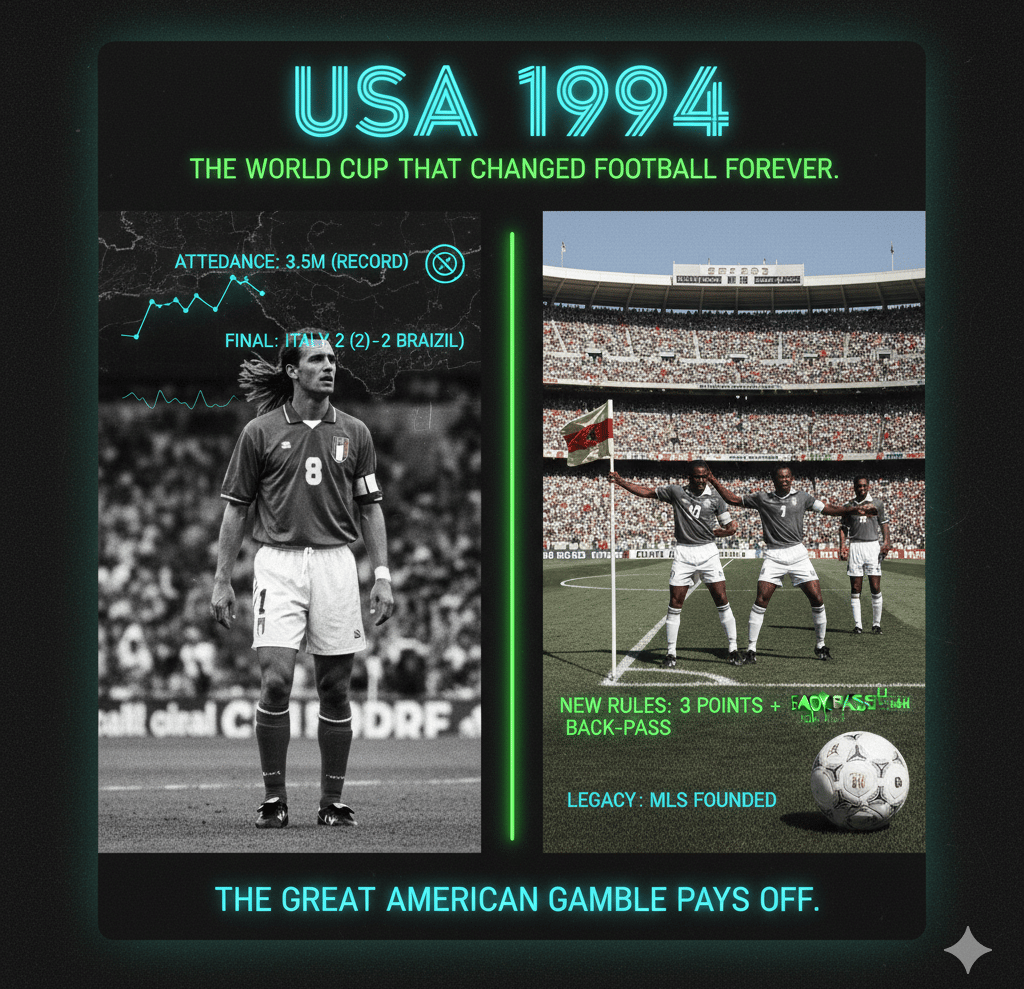
Before 1994, teams were often content to play for a draw, as a win only netted two points. To discourage defensive "anti-football," FIFA adopted a 3-point system for victory. This single change incentivized attacking play and created the high-stakes group stage drama we love today.
2. The Back-Pass Revolution
Perhaps the most significant technical change was the strict enforcement of the Back-Pass Rule. For the first time in World Cup history, goalkeepers were prohibited from picking up a deliberate pass from a teammate’s foot. This forced defenders to be more skillful and goalkeepers to become "sweepers," effectively killing the time-wasting tactics that had plagued the 1990 tournament in Italy.
3. Taking the Game Indoors
The United States proved its architectural might by hosting the first-ever World Cup match played under a roof. The Detroit Silverdome saw the USA face Switzerland in a humid, indoor environment that proved grass could, with enough engineering, grow anywhere.
Legendary Performances: The Icons of '94
The 1994 World Cup was a theater of the unexpected, where veterans and newcomers alike etched their names into the "Dossier" of football history.
Oleg Salenko’s Five-Goal Masterclass: In a single afternoon at Stanford Stadium, Russia’s Oleg Salenko put five goals past Cameroon. It is a record for a single World Cup match that still stands today.
Roger Milla: The Eternal Lion: At 42 years old, Cameroon’s Roger Milla became the oldest goals scorer in the history of the tournament. His hip-shaking corner-flag dance became the defining celebration of a generation.
The Rise of Hagi and Romania: Gheorghe Hagi, the "Maradona of the Carpathians," led a Romanian side that played some of the most beautiful counter-attacking football the world had ever seen, famously knocking out a post-Maradona Argentina.
The Heartbreak of the "Divine Ponytail"
Every great story needs a tragic hero, and in 1994, that was Roberto Baggio. Throughout the knockout stages, Baggio carried Italy on his back, scoring clutch goal after clutch goal with his signature "Divine Ponytail" flying behind him.
The final at the Rose Bowl in Pasadena was the first in history to be decided by a penalty shootout. As the world held its breath, Baggio, the most gifted player of his era, stepped up and sent his penalty soaring over the crossbar. The image of him standing motionless, head bowed, as the Brazilian players celebrated around him remains the most poignant image in World Cup history. It handed Brazil their fourth star and cemented the legend of Romário and Bebeto.
The Legacy: 3.5 Million Reasons Why 2026 is Possible
While Brazil took home the trophy, the real winner was the sport in America. The 1994 World Cup set an attendance record of 3,587,538 fans. Even though subsequent tournaments had more teams and more matches, that 1994 record stood for over three decades.
It proved that the U.S. wasn't just a host; it was a soccer powerhouse in the making. As we look toward the 2026 expansion, with 48 teams and even larger stadiums like the MetLife and SoFi, the goal is finally to break that 1994 record.
USA 1994 didn't just change the rules; it changed the map. It laid the foundation for Major League Soccer (MLS) and ensured that when the world returns in 2026, they aren't coming to a "soccer desert", they are coming home.
💡 Why This Matters for Your "Last Mile" Strategy
If you are planning to attend the 2026 games, understanding the history of 1994 is essential. The stadiums may have changed, but the passion remains the same.
Want to avoid the heartbreak Baggio felt (but for your travel plans)? Check out our Last Mile Dossier for the ultimate logistics breakdown, so you never miss a kickoff.