THE 32-YEAR ODYSSEY: HOW THE USMNT BECAME A GLOBAL TALENT FACTORY
From the "Soccer Desert" of 1994 to the tactical dominance of the 2026 Golden Generation, we break down the three-decade evolution of American soccer. An essential long-form dossier on the players, tactics, and cultural shifts defining the future of the sport.
THE LEGENDS
KICKOFF USA 2026
3/12/202610 min read
From 1994 to 2026: The Rise of the American Golden Generation
Introduction: The 32-Year Odyssey
In the summer of 1994, the United States was a "soccer desert." To the global footballing establishment, the decision to award the World Cup to a nation that lacked a professional outdoor league, a country where "football" meant gridiron and "soccer" was a niche curiosity for suburban children, was viewed with skepticism, confusion, and, in some corners, open derision.
Fast forward 32 years to 2026. The atmosphere is unrecognizable. The United States, co-hosting the largest World Cup in history, no longer enters as an underdog seeking legitimacy. They enter as a nation that has spent three decades building a factory of talent. The "Stars and Stripes" are now led by a Golden Generation, a roster of players who do not just compete in Europe’s elite leagues, they star in them.
This is the definitive dossier of how American soccer transformed from a ragtag group of college stars into a global powerhouse, and why 2026 represents the ultimate climax of this 32-year journey.
Chapter 1: The Soccer Desert (The Pre-1994 Reality)
The landscape of American soccer in 1990 was not merely dormant; it was effectively non-existent in the public consciousness. While the NFL was cementing its grip on Sunday afternoons and the NBA was witnessing the global rise of Michael Jordan, the USMNT was a curiosity, a squad of amateurs and semi-pros competing on the fringes.
In those years, the "Soccer Desert" was a literal description. There were no integrated youth academies, no professional pipeline, and no meaningful media coverage. Players like Tony Meola were forced to balance national team duties with part-time jobs. When the team qualified for Italy 1990, the event was treated as a fluke rather than the start of a trend. The team’s performance, losing to Czechoslovakia, Italy, and Austria, served as a stark reminder of the technical chasm between the U.S. and the global elite.
The skepticism from the European press regarding the 1994 bid was profound. Journalists from footballing heartlands like Argentina and Germany openly questioned whether the U.S. could even adhere to the rules, let alone host a tournament. This skepticism, while condescending, was technically accurate, the country lacked the fundamental "infrastructure of passion" required to sustain a World Cup.
Chapter 2: The 1994 Catalyst – Ground Zero
The 1994 World Cup was a high-stakes gamble by FIFA President João Havelange. It was a bid to force a massive, untapped market into the fold of world football. The mandate to create the MLS was the most significant clause in the contract.
The tournament itself became a theater of cultural transformation. The opening match at Soldier Field, the tension of the penalty shootouts, and the tragic narrative of Roberto Baggio’s miss, these were moments that transcended sport. They became cultural touchstones.
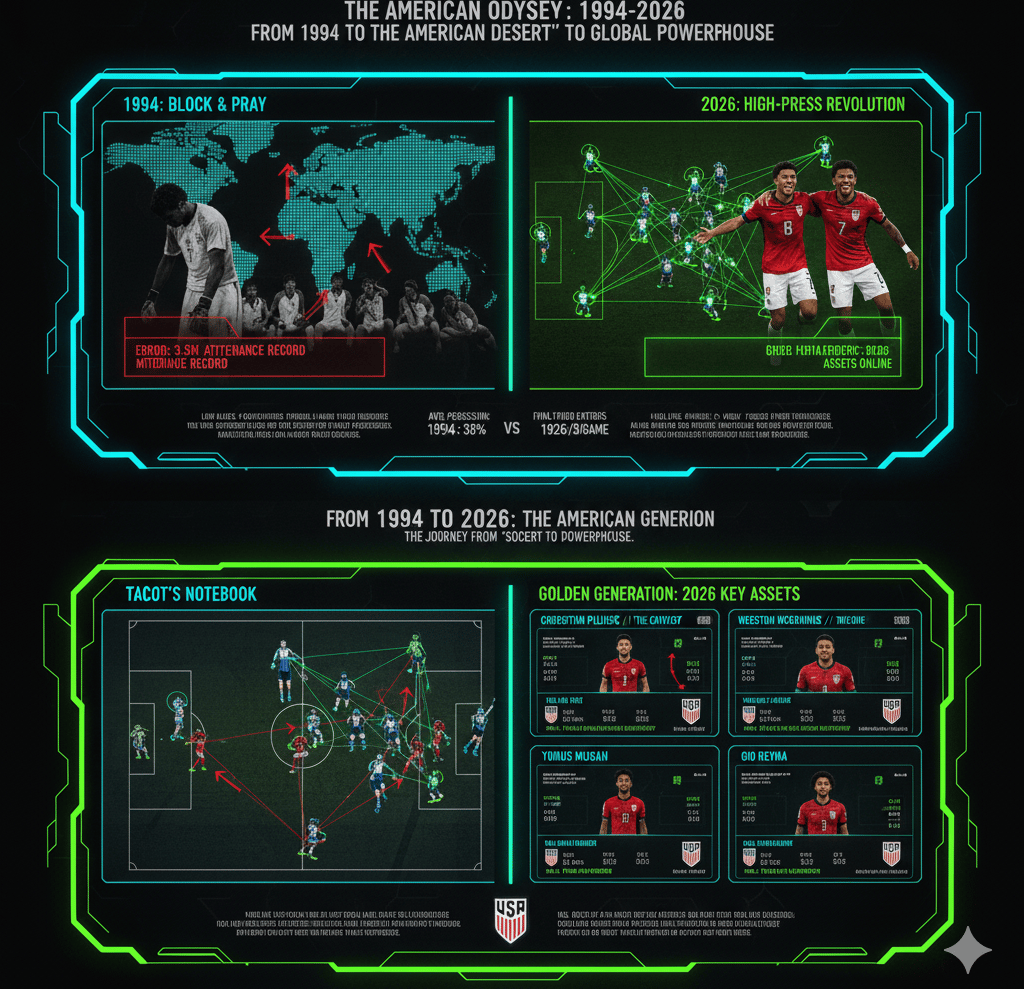
By the end of the tournament, the "soccer desert" had begun to bloom. The attendance record of 3.58 million was not just a statistic; it was a defiant statement of intent from the American public. People who had never watched a match were suddenly hooked by the global drama. The foundation of the current Golden Generation was laid here, not in coaching clinics, but in the millions of American children who, for the first time, saw a World Cup and decided they wanted to be on the pitch.
Culture of The Fan: The Rise of The American Outlaw
If the USMNT’s tactical evolution on the pitch is the brain of the American soccer project, the rise of the supporter culture is its heartbeat. In 1994, the "fan experience" was largely passive, a collection of casual observers, tourists, and families gathered in cavernous NFL stadiums, often with more neutral fans than actual USMNT devotees. The atmosphere was sterile, punctuated by the rhythmic thrum of commercial music rather than the organic, defiant roar of a committed terrace culture.
From Silence to Sound
The shift began in the early 2000s, born out of a collective desire to replicate the visceral intensity seen in the stands of Europe and South America. This movement found its primary vessel in the American Outlaws (AO). Founded in 2007, the AO became the central nervous system of USMNT fandom. They didn’t just show up to watch, they showed up to participate.
The Outlaws, alongside local groups like the Sam’s Army, transformed the USMNT matchday from a corporate sporting event into a theater of identity. They implemented the "drum-and-chant" model, reclaiming the stadium space with synchronized singing, massive tifo displays, and a relentless 90-minute vocal presence that sought to unsettle the opposition rather than just celebrate the home team. This was a radical departure from the polite, clap-along enthusiasm of 1994.
The Ecosystem of local chapters
The beauty of this cultural shift lies in its decentralization. Today, the American Outlaws boast hundreds of local chapters across every state. These chapters serve as the local hubs for footballing life, holding watch parties at 7:00 AM on a Saturday morning to catch European matches, and ensuring that no matter where the USMNT plays, whether it’s a friendly in Nashville or a World Cup qualifier in Columbus, the team walks out to a wall of sound.
This culture of "the fan as a participant" is what makes 2026 feel different from any tournament before it. The fans of 2026 are not just waiting for the stadium to give them a reason to cheer; they are coming with their own songs, their own history, and their own pressure. They understand the nuances of the game, they follow the progress of players like McKennie and Pulisic across the Atlantic, and they view themselves as the 12th man in the tactical setup.
This cultural maturation mirrors the team’s growth: it is no longer performative or forced. It is a genuine, organic expression of a nation that has finally learned how to suffer for, celebrate, and obsess over the beautiful game. When the whistle blows in 2026, the roar from the stands will not be the polite applause of a debutant nation; it will be the thunderous arrival of a global football power.
Chapter 3: The Infrastructure Years (1996–2010)
The years following 1994 were defined by the arduous work of building a pyramid. MLS faced early financial struggles, the "dark ages" of American club soccer, but it remained steadfast in its commitment to the youth academy system.
The Era of the Pioneers
During this phase, the U.S. moved from "relying on grit" to "developing character." We saw the rise of the iconic figures who bridged the gap:
Claudio Reyna: The "Captain America" of the early 2000s, who proved that an American midfielder could orchestrate play in the German Bundesliga.
Landon Donovan: Perhaps the most important player in U.S. history. Donovan made the controversial, yet pivotal, choice to build his legacy at home. He showed the world that MLS could be a place where talent didn't just survive, it flourished.
Tim Howard: A goalkeeper who demonstrated that the U.S. could produce world-class defensive personnel capable of starting for clubs like Manchester United and Everton.
This period was characterized by the establishment of the "Project 2010" initiative, which aimed to make the U.S. a true contender by the turn of the decade. While they didn't win the trophy, they built the bedrock: a professional league, a growing fan base, and a respect for the sport that permeated the American suburban lifestyle.
Chapter 4: The European Export (2010–2020)
The shift between 2010 and 2020 was seismic. Scouts from clubs like Borussia Dortmund, Ajax, and Chelsea began realizing that the American youth system was producing high-energy, tactically astute players.
The Pulisic Effect
The "Pulisic Effect" was the primary engine here. Christian Pulisic didn't just move to Germany; he thrived. When he hoisted the Champions League trophy in 2021, the narrative of "Americans can't play at the top" was incinerated. This led to a massive influx of investment. American players started arriving in Europe with better technical skills, having spent their formative years in academies that mimicked European styles rather than the "kick-and-run" style of American youth soccer in the 90s.
Chapter 5: The Golden Generation (The Modern Era)
We have arrived at the present day. The 2026 USMNT is a collection of high-caliber athletes playing for the biggest clubs on the planet.
Weston McKennie (Juventus): The engine room. His movement and aerial presence represent the modern box-to-box archetype.
Yunis Musah (AC Milan): The technical connector, bringing a level of dribbling and composure rarely seen in American youth history.
Gio Reyna (Nottingham Forest/Dortmund): The creative visionary, capable of unlocking tight defenses with a single pass.
This roster is fundamentally different from 1994. They are tactically versatile, comfortable in high-pressing, possession-based systems that require the technical precision of the best teams in Europe. They don't just "defend and counter"; they dictate the tempo.
To understand the tactical chasm between the 1994 USMNT and the 2026 Golden Generation, one must look at the evolution of the team's relationship with the ball.
The 1994 Philosophy: Discipline in the Block
In 1994, under Bora Milutinović, the U.S. approach was defined by necessity. The tactical goal was simple: survival. The team operated in a rigid, low-to-mid defensive block, prioritizing structural integrity above all else. Because the technical disparity between the U.S. and giants like Brazil was so vast, any attempt to play a high-possession game would have been professional suicide.
The 1994 squad relied on the "Counter-Attack of Opportunity." They invited pressure, absorbed it with a disciplined back five, and waited for moments of transition. Transitions were sparse and often relied on the long ball to target players like Eric Wynalda. It was a game of attrition, a tactical "trench warfare" that demanded high physical endurance but stifled creative fluidity. There was no "build-out from the back" because there wasn't a defensive infrastructure capable of executing it. The ball was a burden to be cleared, not an asset to be managed.
The 2026 Shift: The High-Press & Possession Paradigm
In contrast, the 2026 USMNT is built on the tactical blueprint of modern European elite football: the High-Press.
This evolution is fundamentally a story of confidence and competence. With players like Yunus Musah and Gio Reyna, the USMNT now operates with a system that treats the defensive third as a launching pad rather than a bunker. The "High-Press" is designed to shorten the distance to the opponent’s goal, forcing turnovers in the final third, a strategy that would have been impossible for the 1994 squad to maintain for more than 15 minutes without collapsing from exhaustion.
In possession, the 2026 side uses a "positional play" (Juego de Posición) framework. The fullbacks push high to provide width, the midfielders act as "rhythmic controllers" (a role that did not exist in the 90s U.S. setup), and the forwards are encouraged to rotate and interchange. This shift from "defend-and-wait" to "press-and-dictate" is the greatest tactical leap in U.S. history.
This isn't just a change in strategy; it is a change in status. The 1994 team played as if they didn't belong in the tournament, and their tactics reflected that fear. The 2026 team plays with the tactical arrogance of a squad that expects to have the ball at their feet, comfortable in the knowledge that they are as technically proficient as the giants they once feared. This tactical maturation is the ultimate "Last Mile" of the American journey, the point where, for the first time, the U.S. is not playing against the opponent, but against their own standards.
The Scout's Notebook: Profiling The Golden Generation
To understand the trajectory of the U.S. Men’s National Team heading into 2026, one must analyze the individuals who have turned potential into performance. These are not merely talented players; they are the standard-bearers of a new tactical philosophy.
1. Christian Pulisic: The Catalyst
If the USMNT has a heartbeat, it is Pulisic. Often criticized early in his career for the weight of expectations, Pulisic has evolved into a clinical, high-IQ winger. His role in the modern system isn't just to score; it is to draw defensive coverage, creating corridors of space for overlapping fullbacks or late-arriving midfielders. His technical ability in the "half-space", the area between the opponent's fullback and center-back, is the single most dangerous weapon in the U.S. arsenal.
2. Weston McKennie: The Tactical Engine
McKennie is the physical manifestation of the U.S. shift toward the "High-Press." His capacity to cover ground is elite, but his tactical intelligence in knowing when to trigger a press is what separates him from the box-to-box midfielders of the 90s. He acts as the team's defensive stabilizer, allowing the more creative players to venture forward with the assurance that their defensive transition is covered.
3. Yunus Musah: The Rhythmic Controller
Musah represents the "La Masia" influence. His ability to receive the ball under intense pressure, turn, and drive through the midfield with the ball glued to his feet is the hallmark of the modern USMNT. He is the link that connects the defense to the attack, providing the team with the "rhythm" needed to dictate possession against elite international sides.
4. Gio Reyna: The Creative Visionary
Reyna is the player the U.S. never had in 1994. In the final third, he operates with a level of patience and vision that allows him to thread passes through the narrowest of defensive seams. His role is to be the "10", the master of the final ball. His development in the Bundesliga has taught him the patience to wait for the perfect moment, a stark contrast to the rushed long-ball tactics of the past.
5. The Rising Wall: The Defensive Anchor
The current defensive unit—anchored by aggressive, ball-playing center-backs, marks the final piece of the tactical puzzle. Unlike the defenders of 1994, whose primary directive was to clear the ball into the stands, today’s defenders are comfortable playing out from under pressure. They initiate the attack, using long, diagonal passes to switch the point of attack, stretching the opponent's defensive block to its breaking point.
Chapter 6: 2026 – The Ultimate Test
The 2026 World Cup, with 48 teams, is the stage where this 32-year journey reaches its crescendo. The USMNT will play in stadiums that are marvels of modern engineering, in front of crowds that will dwarf the 1994 records.
The Expectation Shift
Expectations are no longer focused on "making the knockout round." The expectation is a deep run, a challenge to the global powers like France, Argentina, and England. The team has the talent, the tactical maturity, and the home-field advantage.
The pressure is high, but the infrastructure is ready. For the first time in history, the U.S. is entering a World Cup where their starting XI is entirely composed of players who have cut their teeth in the "Big Five" leagues.
Conclusion: The Climax of a 32-Year Journey
As you prepare to walk through the gates of SoFi Stadium in 2026, take a moment to consider the path. You are not just attending a match; you are witnessing the realization of a project that began with the skepticism of 1994.
The "Soccer Desert" is gone. In its place stands a nation that has fundamentally re-engineered its athletic priorities, its youth development, and its place in the global sport. The Golden Generation is ready. The infrastructure is battle-tested. The world is watching.