THE BATTLE OF LUSAIL: ANATOMY OF THE DIRTIEST MATCH IN WORLD CUP HISTORY
18 yellow cards, 1 red, and a bench-clearing melee. We dissect the 2022 quarter-final between Argentina and the Netherlands to understand how elite tactical pressure devolved into football’s most chaotic war—and why 2026 might bring even more intensity.
THE LEGENDS
KICKOFF USA 2026
3/15/20266 min read
The Battle of Lusail: Inside the Dirtiest Match in World Cup History
On December 9, 2022, the Lusail Stadium in Qatar, typically a venue of meticulously planned grandeur, became the unlikely stage for a gladiatorial contest that transcended the beautiful game. The quarter-final clash between Argentina and the Netherlands, a fixture laden with historical weight and tactical intrigue, devolved into a spectacle of raw emotion, relentless antagonism, and unprecedented disciplinary chaos. While Argentina eventually advanced on penalties, securing their berth in what would become a legendary final, the football itself was almost entirely overshadowed by the record-breaking hostility that permeated every blade of grass on the pitch.
This wasn't just a match; it was an explosion of bottled-up tension, a masterclass in the psychological warfare that underpins elite-level knockout football. It left an indelible mark on the tournament, on the careers of those involved, and on the very definition of what constitutes "fair play" in the pursuit of the ultimate prize.
Why was it called a "Battle"? The Unraveling of Order
The term "Battle of Lusail" wasn't hyperbole; it was a journalistic necessity to describe the sheer ferocity of the encounter. At the heart of the disciplinary maelstrom was Spanish referee Antonio Mateu Lahoz, a figure known for his idiosyncratic officiating style and a tendency to engage verbally with players. On this night, however, even Lahoz, who had managed major European derbies and Champions League fixtures, seemed overwhelmed by the escalating animosity. He issued a staggering 18 yellow cards throughout the match, the most in any single FIFA World Cup match in history. This wasn't merely a statistic; it was a symptom of a game that had lost its conventional moorings, a contest where the line between aggressive play and outright provocation became increasingly blurred.
The match had a slow burn, with the initial fouls and bookings feeling like standard knockout stage fare. Argentina, driven by the singular ambition of securing Lionel Messi's elusive World Cup, played with an intensity bordering on desperation. The Netherlands, under the pragmatic genius of Louis van Gaal, responded with a disciplined but equally resolute approach. Neither side was willing to yield an inch, physically or mentally.
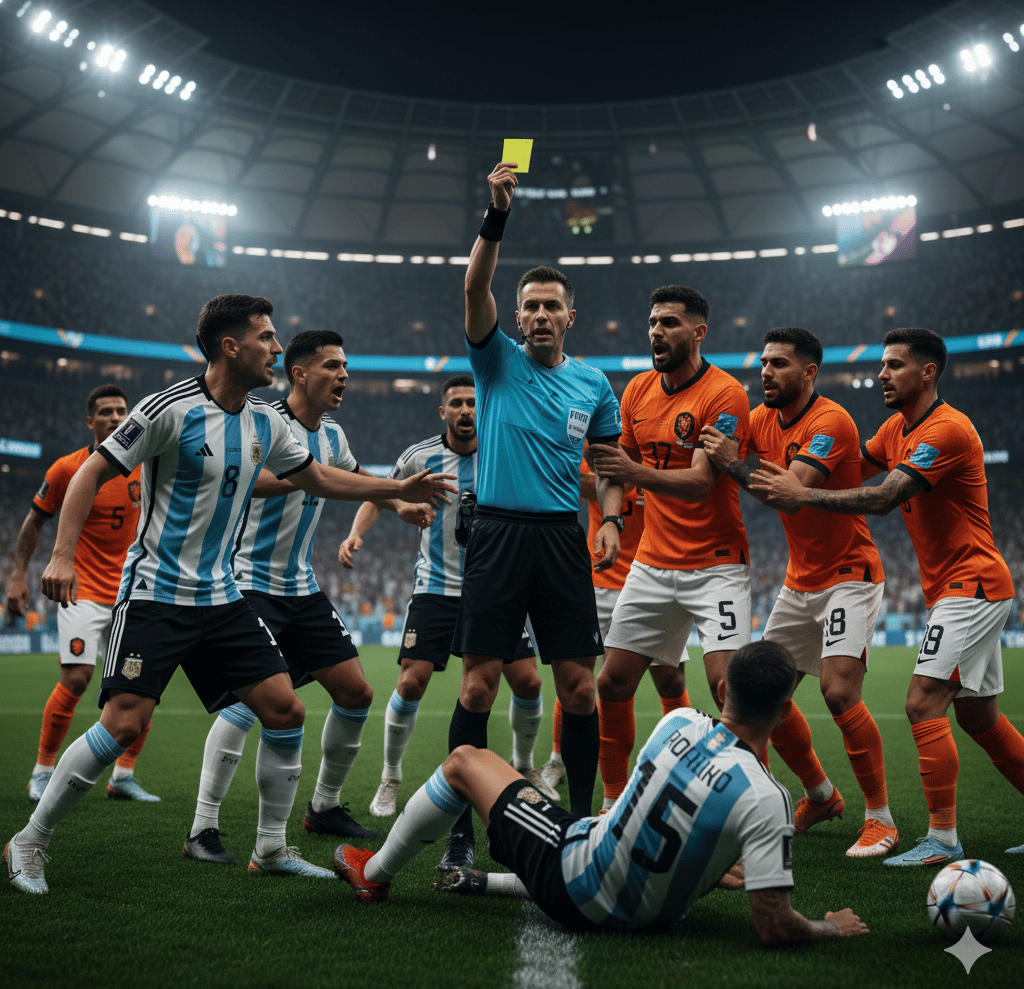
The tension, however, reached a boiling point in the 88th minute, a moment etched into the collective memory of football fans. With Argentina leading 2-1 and seemingly on their way to victory, midfielder Leandro Paredes committed a hard, cynical foul on Nathan Aké. It was a clear booking offense, designed to break up play and waste time. But Paredes didn't stop there. In an act of pure, unadulterated provocation, he proceeded to smash the ball directly into the Dutch technical area, right in front of their bench.
The reaction was instantaneous and explosive. Netherlands captain Virgil van Dijk, usually a picture of stoic composure, charged across the pitch like a man possessed, leveling Paredes with a shoulder barge that sent the Argentine sprawling. What followed was a massive bench-clearing confrontation involving players, coaches, and staff from both sides. It was a chaotic scene, a melee of pushing, shoving, and shouting, where rivalries boiled over into outright animosity. Lahoz struggled to regain control, issuing multiple bookings in the aftermath, but the damage was done. The psychological warfare had escalated into an all-out physical and emotional conflict.
Messi vs. Van Gaal: A Grudge Match Beyond the Pitch
The "Battle of Lusail" wasn't just a clash of players; it was a clash of titans, epitomized by the simmering animosity between Lionel Messi and Dutch manager Louis van Gaal. The seeds of this personal rivalry were sown in the days leading up to the quarter-final, with Van Gaal making pre-match comments that Messi found profoundly disrespectful. Van Gaal had publicly stated that his team held an advantage in a penalty shootout, subtly hinting that Messi did not contribute enough defensively and could be neutralized. For a player as fiercely proud and often stoic as Messi, these comments cut deep.
The tension manifested itself spectacularly during the match. After converting a crucial penalty in the 73rd minute to put Argentina 2-0 up, Messi turned directly towards the Dutch dugout and celebrated with a gesture famously known as "The Topo Gigio", cupping his ears with his hands. This was a direct, unambiguous message to Van Gaal, an iconic celebration first popularized by Argentine legend Juan Román Riquelme, who famously used it against Van Gaal during his time at Barcelona to express his frustration with the manager. Messi, who rarely engages in such overt displays of defiance, was channeling a historical grievance, making it clear that Van Gaal's words had been heard and would not go unpunished.
But the animosity didn't end on the pitch. Following Argentina's dramatic victory in the penalty shootout, a visibly enraged Messi confronted Van Gaal directly. The images of Messi, typically reserved and humble, standing nose-to-nose with the veteran Dutch coach, are some of the most enduring from the tournament. In a post-match interview that immediately went viral globally, Messi, still seething, famously snapped at Dutch striker Wout Weghorst (who had scored both Dutch goals), yelling, "What are you looking at, bobo? Go back there!" (meaning, "What are you looking at, fool? Go back to your place!"). This unfiltered outburst from a usually composed icon highlighted the extraordinary emotional toll the match had taken. It was a glimpse into the raw, competitive fire that burned within Messi, a fire intensified by his singular quest for the World Cup trophy.
The Record Books: A Disciplinary Aberration
The statistical breakdown of the "Battle of Lusail" paints a picture of a game truly unlike any other:
Total Yellow Cards: 18 (An all-time FIFA World Cup record for a single match)
Red Cards: 1 (Denzel Dumfries, who received two yellow cards during the penalty shootout itself, an unprecedented event that further underscored the chaos)
Final Score: 2-2 after extra time (Argentina won 4-3 on penalties)
Fouls Committed: 48 (28 by the Netherlands, 20 by Argentina) – another testament to the physical nature of the game.
The sheer volume of cards and fouls wasn't merely a reflection of a strict referee. It was a clear indicator that players on both sides were operating at the absolute edge of their emotional and physical limits. Every tackle felt like a statement, every challenge carried a psychological weight. The match became a study in the breakdown of sporting decorum under extreme pressure, where the desire to win superseded almost everything else. It forced a global conversation about the role of the referee, the responsibility of players, and the acceptable boundaries of competitive spirit.
The Legacy of Lusail: A Blueprint for Future Intensity?
The "Battle of Lusail" serves as a stark reminder of the intensity that defines World Cup knockout football. While the disciplinary record is unlikely to be broken frequently, the underlying psychological warfare and the sheer will to win are constants. For Argentina, it was a pivotal, character-defining moment on their path to glory. They proved they could win not just with Messi's magic, but with an almost primal fighting spirit. For the Netherlands, it was a bitter end, but one that showcased their resilience and tactical discipline under immense pressure.
As we look ahead to the 2026 World Cup, this match takes on new significance. Will the expansion to 48 teams bring even more intensity, more such "battles"? With the stakes higher than ever, and more nations vying for glory, the emotional temperature of the tournament is only set to rise. The introduction of the Round of 32 means teams will have to maintain this level of intensity for an extra knockout game, pushing players, coaches, and officials to their absolute limits.
The "Battle of Lusail" wasn't an anomaly; it was a potent demonstration of what happens when two elite teams, driven by unyielding ambition and fueled by personal grievances, collide on the biggest stage. It showcased the raw, untamed heart of football, where passion can boil over, and every decision, every tackle, every word exchanged carries monumental weight.
The 2026 tournament, with its unprecedented scale and complexity, promises drama on a new level. The logistical challenges, the grueling 39-day marathon, and the sheer number of teams all converge to create an environment ripe for such explosive encounters. Teams will be pushing boundaries, managers will be engaging in psychological ploys, and players will be fighting for every inch.
The question isn't if we will see another "Battle of Lusail" in 2026, but when and where. The expansion to 48 teams, by increasing the competitive landscape and pushing teams through a more grueling knockout path, will only amplify these high-stakes collisions. Fans, prepare yourselves. The intensity of 2022 was just a preview. The real war for the World Cup begins in North America.
Don't miss the 2026 drama! Will the 2026 tournament bring even more intensity? With the expansion to 48 teams, the stakes have never been higher.
⚽ Check the 2026 Kickoff Countdown Here